youtube / available
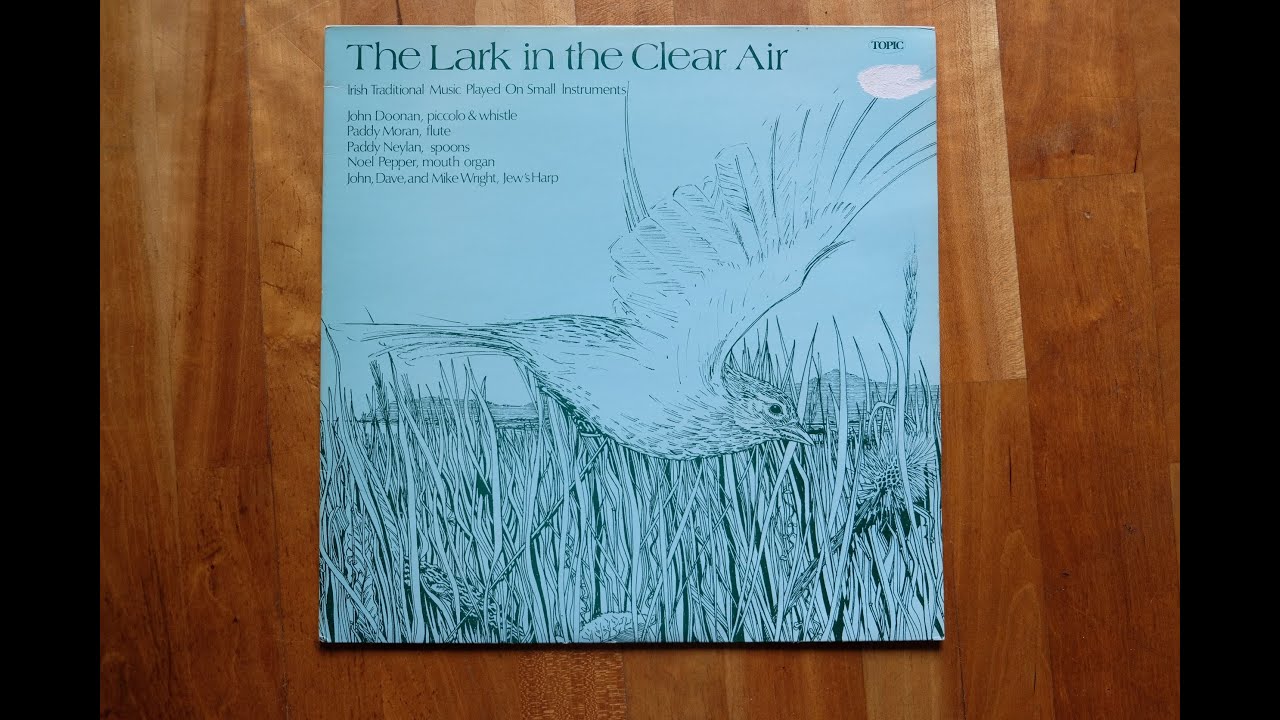
The Lark in the Clear Air - Irish Music
Uploaded by Joch Vomberg
Celtic folkUnidentified upload

Uploaded by Vingul. Identification candidates are research leads, not confirmed recording metadata.
YouTube playback is for listening and research only. A public upload does not authorize sampling or production use; producers must obtain audio and permissions separately.
These values are unconfirmed candidates, not established artist or release facts.
No identification candidates were parsed from this upload.
No track timestamps were parsed from this upload.
Unidentified upload. No recording candidate has been established.
No external evidence is attached to these candidates.
Full album. CD notes from Two Worlds of the Welsh Harp (Dorian DOR-90260) by William Taylor: Two Worlds of Welsh Harp Music from the Robert ap Huw manuscript (1613) and the volumes of Edward Jones's Musical and Poetical Relicks of the Welsh Bards (1784-1825) played on historical harps by William Taylor 1. Gosteg Dafydd Athro/Gosteg of Master David, Robert ap Huw ms. 2. a. Y ddigan y droell/Erddigan of the spindle-whorl, Robert ap Huw ms. b. Troiad y Droell/The Whirling of the Spin-ning Wheel, Edward Jones, 1802 3. Kaniad y gwynn bibydd/Caniad of the white piper, Robert ap Huw ms. 4. Kaniad San Silin/Caniad of St. Silin, Robert ap Huw ms. 5. a. Tôn y Brenhin/The King's Note, Edward Jones, 1820 b. Tyb y Brenhin Siarles/King Charles's Fancy, Edward Jones, 1802 c. Hoffedd y Brenhin/The King's Fancy, Edward Jones, 1802 6. Kaniad ystafell/Caniad of the chamber, Robert ap Huw ms. 7. a. Distyll y Donn/The Ebb of the Tide, Edward Jones, 1784 b. Kaniad bach ar y gogower/Little caniad on the gogywair tuning, Robert ap Huw ms. 8. Sidanen/The Silken-fair, Edward Jones, 1802 9. Canu yn iâch i Dwm bâch/Little Tom's Adieu, Edward Jones, 1820 10. a. Kaingk Dafydd Broffwyd/Cainc of David the Prophet, Robert ap Huw ms. b. Caingc Dafydd Brophwyd/Cainc of David the Prophet, Edward Jones, 1802 Harps: 12th c. Romanesque harp, 'Cithara Anglica', 21 strings, by Rainer Thurau, 1990: 4 15th c. Bray harp, after Bosch, 24 strings, by Rainer Thurau, 1987: 2a, 3, 10a 16th c. Bray harp, 29 strings, by David Brown, 1992: 1, 2b, 5, 6, 7a, 7b, 8, 9, 10b This programme contrasts two completely different repertoires of historical harp music from Wales. On one hand, we have a body of music in the Robert ap Huw manuscript (British Library Add. MS. 14905), written down in 1613, which is clearly medieval in character; on the other hand we have Edward Jones's antiquarian collections of music, printed less than 200 years later. One points towards fact, the other towards historical fiction, giving a new music without ritual function, serving as a curious entertainment. What lies between is a rapidly changing society, emerging out of a native Welsh culture, which originally had the security and the means to foster a tradition of elaborate formal literature and music, into a culture subsumed by bourgeois taste. It must be said that this new music is not a transformation of the older repertoire. Rather, it consists of English and Continental dance tunes which have been 'antiquised', that is to say, assigned to the remote past by way of their titles. The same sort of harp would have played both the medieval music and the new quasi-historical music of the 18th century. From the late 14th century to the 17th century, the 'Gothic' harp, with its distinctive buzzing bray pins, was heard all over Europe, and was particularly favoured in Wales. The Robert ap Huw manuscript clearly calls for the bray harp, to be played with fingernails, whilst damping rigourously with the finger pads. Indeed, a number of Welsh poems of the later Middle Ages accurately describe the brays (small crooked pegs which hold the strings into the soundbox, and lightly touch them, causing the strings to buzz) and praise their expressive power, as having the ability 'to speak every profound feeling'. [1] In her article, 'Edward Jones's Musical and Poetical Relicks of the Welsh Bards, 1784: A Re-assessment', Joan Rimmer remarks, 'harps, of course, were not peculiar to Wales. The ascertainable history of that kind of instrument there reveals that a standard European renaissance harp with brays was in use in Wales in the 16th century and was regarded in the late 17th century as 'the proper Welsh harp'. Jones described the triple harp as 'the modern Welsh harp', without any reference to its non-Welsh origins, of which he was certainly unaware.' [2] As new developments in harp construction arose, older designs continued in use, so that in Edward Jones's day, Welsh harpists could be found playing either the bray harp; the single-row staved-back harp without brays; the Welsh triple harp; or the new pedal harp. The performance of music in Edward Jones's collections would have presented a challenging struggle to the few remaining 18th-century bray harpists, who may have been pressed to play the latest tunes. [liner notes cut off here for space reasons]
Uploaded by Joch Vomberg
Celtic folkUnidentified upload
Uploaded by calefonxcalectric
Celtic folkUnidentified upload
Uploaded by calefonxcalectric
Celtic folkUnidentified upload
Uploaded by Το φιλί της Πεταλούδας
Celtic folkUnidentified upload
Uploaded by Joch Vomberg
Celtic folkUnidentified upload
Uploaded by Joch Vomberg
Celtic folkUnidentified upload

Uploaded by Joch Vomberg
Celtic folkUnidentified upload